A guide to drain build over work starts with one fact many homeowners discover too late: the pipe beneath a proposed extension may not belong to them. A drain can be private, shared or maintained by the local water company, and the rules change accordingly. Getting this clear before foundations are designed can prevent delays, rejected applications, damage to pipework and a difficult problem when the property is sold.
For homeowners, landlords and developers across the West Midlands, the sensible approach is diagnosis first. Locate the pipe, establish who is responsible for it, assess its condition and obtain the right approval before work starts. Building over a drain is sometimes possible. Building over the wrong drain, without permission or with no future access, can become expensive very quickly.
What does building over a drain mean?
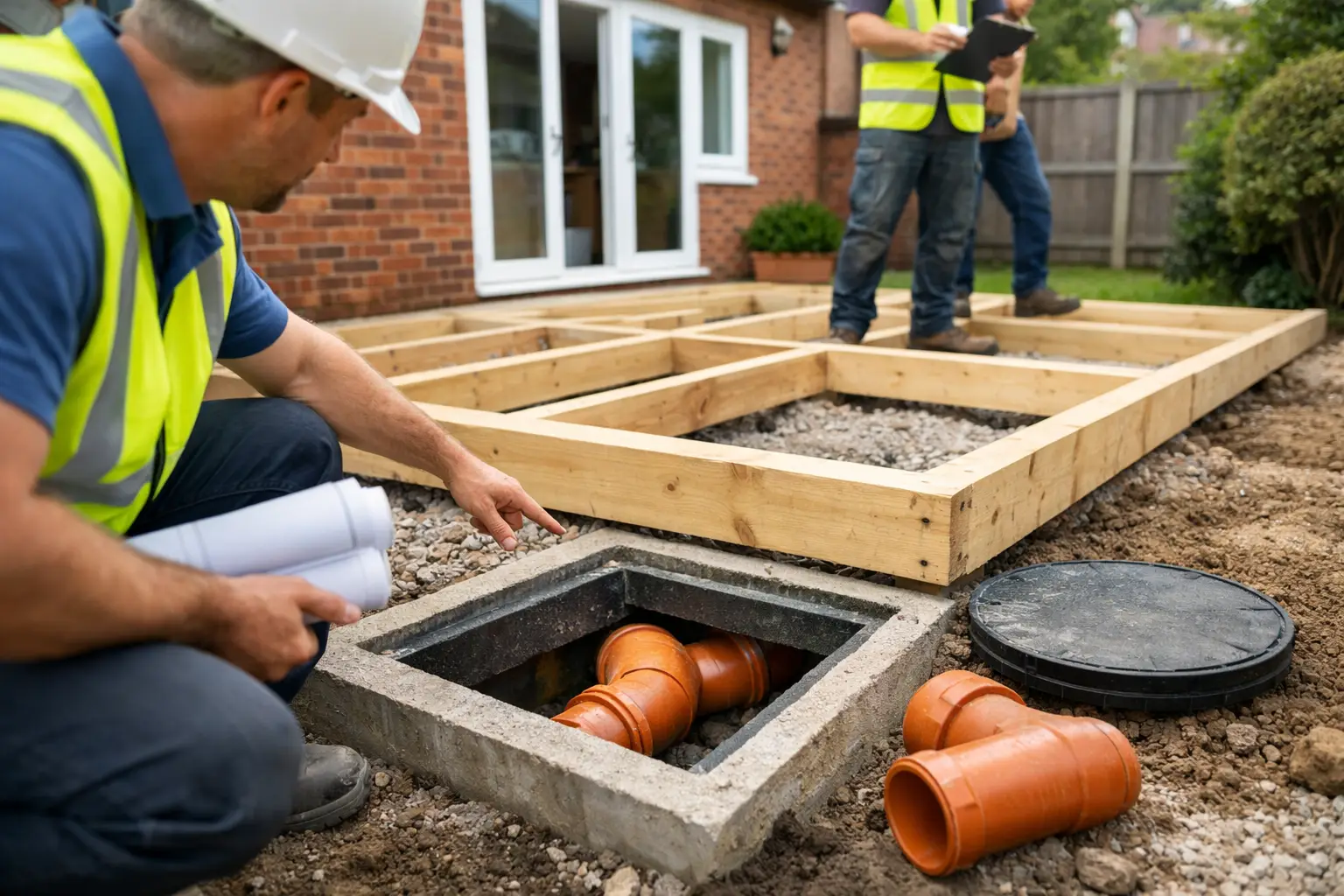
A build over is any permanent structure placed above or very close to underground drainage. In practice, this is most often a rear or side extension, conservatory, garage, new room, retaining structure or substantial paved area. The concern is not simply the weight above the pipe. Builders must also consider whether foundations could crush or displace it, whether movement could cause cracks, and whether anyone could reach the sewer if it blocks or collapses later.
People often use drain and sewer interchangeably, but the distinction matters. A private drain normally serves one property within its boundary. A lateral drain may run from a property to the public sewer, often beyond the boundary. A public sewer can serve several properties or form part of the water company network. Some pipework that appears to be in a private garden may still be public.
The 2011 transfer of many private sewers and lateral drains to water companies made this less obvious. Never rely solely on the age of the property, the position of a manhole or a previous owner’s description.
Why a drain build over needs checks before design
Extensions are easiest to alter on paper, not once excavations are under way. An early drainage survey gives an architect, builder and Building Control team reliable information about the route, depth, diameter, material and condition of the pipework.
A CCTV drain survey is usually the most efficient starting point. A camera is sent through the line to record defects such as cracks, displaced joints, root ingress, scale build-up, poor connections or a partial collapse. It also helps trace the route beneath the property and identify whether the line connects with neighbouring homes.
This investigation can reveal whether the pipe needs repair before the extension proceeds. Covering a damaged clay drain with a new floor and foundations does not make the issue disappear. It can leave the property with recurring blockages beneath an area that is costly to excavate.
Survey findings should be recorded in a clear report with footage, pipe measurements and a drainage plan where required. This provides evidence for the water company, Building Control, your designer and, later, a buyer’s solicitor.
Private drains, shared drains and public sewers
The permissions needed depend on the pipe’s ownership and location. If the proposed work affects a public sewer, you will commonly need a build over agreement from the relevant water company. This is separate from planning permission and separate from Building Regulations approval. One does not replace the other.
Water companies commonly require an application when a structure will be built over or close to a public sewer, often within a specified distance such as three metres. Their requirements vary by company and by the size, depth and importance of the sewer. Large, deep or strategic sewers may not be suitable for building over at all. Diversion may be the only acceptable option.
A private drain does not automatically mean there are no controls. Building Control will still want to see that the drainage arrangement, foundations and access provisions comply with Building Regulations. Where a drain is shared, it can also involve legal responsibilities and practical agreement with neighbours.
The safest rule is simple: do not make assumptions from a drainage drawing alone. Maps can be incomplete, and site conditions may differ from records. Use the drawing as a starting point, then confirm the pipework on site.
The usual build over process
1. Locate and inspect the drainage
Start with a CCTV survey and, where necessary, drainage tracing. This establishes the route and checks that the pipe is flowing freely. If there is a blockage, structural damage or root intrusion, deal with it before construction. High-pressure water jetting may clear debris, but a camera inspection is what confirms whether a deeper fault remains.
2. Check the proposal against the pipe route
Your designer should overlay the survey information onto the proposed extension plans. This is where potential conflicts with foundations, internal soil pipes, manholes and new inspection chambers become clear. It may be cheaper to adjust the footprint of an extension than to divert a sewer after designs have been submitted.
3. Apply for approval where required
For public sewers, submit the proposed drawings, drainage information and survey evidence to the relevant water company before work begins. They may specify foundation details, protective measures, access requirements, inspection points and a post-construction survey. Do not treat this as a paperwork exercise. These conditions are intended to protect a live asset that may need repair years after your extension is complete.
4. Coordinate Building Control and the builder
The builder needs the approved details before excavation starts. Foundations may need to bridge over the pipe rather than load directly onto it, with the design confirmed by a structural engineer where necessary. New access chambers may need to be positioned outside the extension, and internal manholes are generally avoided unless a specific approved arrangement is in place.
5. Inspect and record the completed work
A final CCTV survey can show that the drain has not been cracked, displaced or obstructed during construction. Keep the footage, report, approvals and completion paperwork with your property records. It is useful evidence for insurance queries and can prevent a last-minute scramble during conveyancing.
Common mistakes that cause delays
The biggest mistake is starting groundwork before the drainage route has been confirmed. A builder may uncover a pipe precisely where a foundation is planned, stopping the job while ownership, permissions and redesign are worked out.
Another common issue is assuming an old manhole can simply be covered. Access points exist for a reason. If a public sewer blocks, the water company must be able to maintain it. Moving or replacing an inspection chamber needs proper design and approval, not an improvised solution beneath a new kitchen floor.
Poor pipe condition is also regularly overlooked. Old clay pipework can be sound, but it is vulnerable to cracked joints and root ingress. If excavation is limited or the pipe sits beneath a finished extension, no-dig CIPP relining may provide a durable repair without opening large sections of ground. Whether relining is suitable depends on the defect, diameter, access and the approval requirements for the line.
Finally, do not confuse planning permission with drainage consent. Planning focuses on the development itself. Build over consent concerns the water company’s sewer and its future maintenance. Both may be needed, alongside Building Regulations approval.
What if an extension has already been built over a drain?
This often comes to light during a house sale, remortgage, insurance claim or survey. The right next step is not to guess. Arrange a CCTV inspection to establish the pipe’s condition and route, then gather any Building Regulations completion certificates, plans and historic permissions.
If no build over agreement was obtained for a public sewer, speak to the relevant water company or seek advice from a qualified drainage professional before offering assurances to a buyer. Retrospective approval is not guaranteed, and the outcome depends on the structure, access, sewer type and survey findings. A clear evidence trail gives you the best chance of resolving the issue sensibly.
When to call a drainage specialist
Bring in a drainage specialist before finalising plans if there is a manhole near the proposed extension, recurring drainage trouble, a shared connection, an older property or uncertainty over the pipe route. It is particularly worthwhile where drawings show a drain close to foundations or where the work will cover existing access.
West Midlands Drainage can carry out CCTV surveys, trace drainage runs, clear blockages and identify repair options before construction decisions are locked in. The aim is straightforward: give you an honest picture of what is underground so your builder can do the job properly, with fewer surprises once the ground is opened.
A well-planned extension should not leave you worrying about a hidden drain beneath it. Check the line early, keep the paperwork and make sure any repair or approval is completed before concrete is poured. That small amount of preparation protects both the new space and the property beneath it.