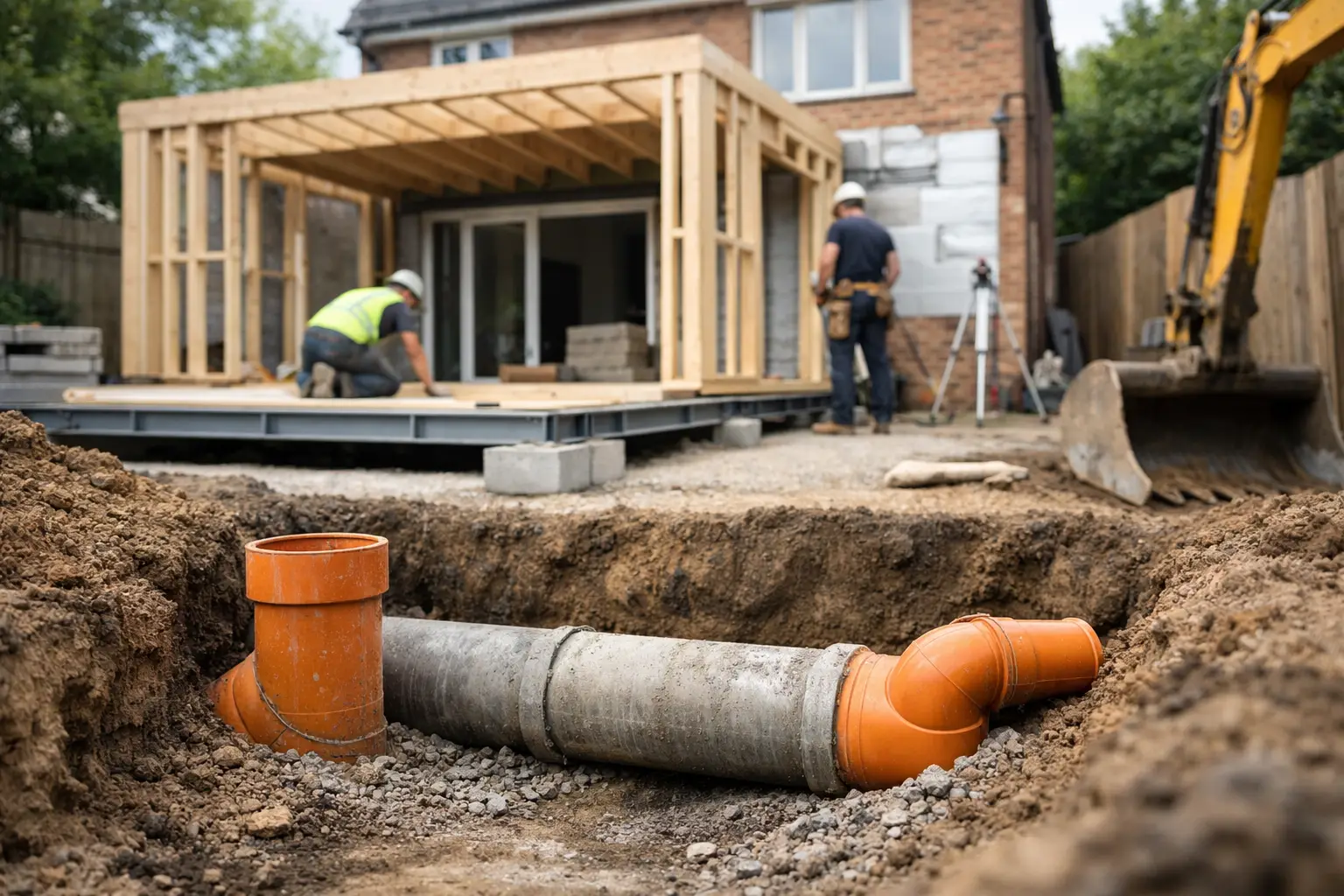
A building extension over sewer pipes can turn into an expensive problem long after the builders have left. If a pipe collapses beneath the new floor, blocks repeatedly or needs access for repair, the cost is no longer just drainage work. It can mean lifting finished flooring, disrupting the extension and dealing with questions from Building Control, insurers or a future buyer.
The good news is that most drainage risks can be identified before construction starts. The key is to establish exactly where the drains run, who is responsible for them and whether the proposed extension needs formal approval from the local water company.
Can you build an extension over a sewer?
Sometimes, yes. But it depends on the type, size and location of the sewer, as well as the proposed construction. You should never assume that because a pipe is buried in your garden, it is a private drain that can simply be built over.
Many sewers serving more than one property were transferred to water companies in 2011. In the West Midlands, that commonly means Severn Trent Water has responsibility, although ownership must be checked for the individual site. A pipe can also be public because of its route or formal adoption, even if it appears to serve one property.
Where a public sewer runs within or close to the footprint of a planned extension, a Build Over Agreement may be required. This is permission from the water company to build near or above its asset. The precise requirements vary, but an extension within three metres of a public sewer will usually need to be referred to the water company before work proceeds.
Building Control approval and planning permission do not replace a Build Over Agreement. They are separate processes. Your builder, architect or structural engineer may help coordinate the applications, but the property owner should make sure the drainage position is resolved in writing.
Why the sewer route matters before foundations are dug
Drainage drawings are useful, but they are not always accurate enough to base construction on. Older homes may have altered pipework, redundant branches, shared connections or manholes that do not appear on a plan. Extensions can also uncover defects that were already present but had not yet caused a visible issue.
A CCTV drain survey gives a clear view inside the pipe. A camera is fed through the drainage system to record the route, depth where available, pipe material, joints and condition. It can reveal cracks, displaced sections, root ingress, scale build-up and signs that the pipe is already deforming.
That information helps answer practical questions before the build gets underway. Can the extension be moved slightly to avoid the sewer? Is the pipe in sound enough condition to remain in place? Does a drain need repairing or relining first? Is there an inspection chamber that needs relocating outside the new building line?
For an extension project, a survey should not be treated as a box-ticking exercise. It is evidence of the drain’s condition before construction. If the pipe is damaged afterwards, a pre-work recording can help establish whether the problem was pre-existing or caused during the works.
When a Build Over Agreement may not be suitable
Not every sewer can be built over. Water companies generally apply stricter rules to larger, deeper or strategically important sewers. A pipe that carries flow from several properties, a rising main or a large-diameter sewer may be unsuitable for building over altogether.
Even where an agreement is possible, the design may need changing. The water company may require suitable clearance around the pipe, foundations designed to avoid loading it, and permanent access points outside the extension. Internal manholes are normally a problem because drainage operatives need safe access without entering your kitchen, utility room or living space.
The options usually come down to altering the extension footprint, diverting the sewer, or designing the foundations to bridge over it. A diversion can be a significant piece of work and will normally need the water company’s approval and inspection. Bridging foundations can be feasible, but it is a structural design matter as well as a drainage one. It should be designed by a competent structural engineer, not improvised on site.
Private drains need care too. You may have more freedom to alter a private pipe, but it still needs to work reliably, remain accessible for maintenance and meet Building Regulations. Moving a manhole to a sensible external position is often far cheaper than discovering a blockage beneath a finished extension later.
The right order for a building extension over sewer pipes
The best time to deal with drainage is at the design stage, before plans are fixed and materials are ordered. Start by asking whether the property has drainage plans and whether the route is known. Then arrange a CCTV survey and surface inspection of manholes, gullies and connections.
Once the route has been confirmed, the proposed extension can be checked against it. If the sewer is public or likely to be public, contact the relevant water company early. Do not wait until excavation has started. Approval applications can require plans, pipe details, survey footage and engineering information, and conditions may affect the final layout.
If defects are found, repair them before the extension is built. A displaced joint or root-damaged section may be suitable for no-dig CIPP relining, which creates a new lining inside the existing pipe without opening up the full run. In other cases, excavation and replacement is the sounder option. The right repair depends on the pipe’s condition, size, access and whether the construction plans require a specific solution.
During the build, make sure the drainage route is clearly marked and protected from excavation plant, spoil heaps and heavy vehicle loading. Builders should not use the drains as a route for cement washout, plaster, grout or site debris. These materials harden inside pipework and can cause a blockage that will not respond to a simple plunger or domestic drain cleaner.
A final CCTV survey after the drainage work and construction activity is good practice, particularly where a pipe passes close to foundations. It confirms the line remains open and undamaged, and provides a record for your project file.
Common mistakes that cause trouble later
The most common mistake is relying on an old plan or a neighbour’s assumption about where the drain runs. The second is treating a shared drain as private because it is on private land. Neither is enough when a new structure may restrict access to a sewer for decades.
Another avoidable issue is building over an inspection chamber without relocating it. Covers beneath flooring may look tidy on completion, but they create an obvious access problem when the drain backs up. Odours, flooding and emergency drainage work are not something any homeowner wants inside a new extension.
Some owners also discover the lack of approvals when selling. Solicitors may ask for Build Over Agreement paperwork, drainage reports and evidence of Building Regulations compliance. An indemnity policy may sometimes be discussed during conveyancing, but it does not repair a damaged pipe or guarantee that future access and maintenance issues will disappear.
What a drainage contractor should check
For planned extension work, a proper drainage assessment should go beyond confirming that water currently flows away. The contractor should identify the pipe material and likely ownership, inspect connections and chambers, note faults, and explain where the route conflicts with the design.
At West Midlands Drainage, we use CCTV inspection to diagnose the condition and route of underground pipework before avoidable problems are covered by concrete, foundations or finished floors. If repair work is needed, we explain the cause and the practical options rather than recommending a temporary fix that leaves the same risk beneath the extension.
For landlords and commercial property operators, keep the survey report, footage, drawings and any approval documents with the property’s maintenance records. This is useful for planned maintenance, insurance queries and future alterations, especially where several units share drainage runs.
A new extension should add usable space, not hide a drainage liability. Confirm the sewer route, get the required approvals, repair faults before they are sealed in and keep evidence of every stage. That small amount of preparation can protect the value of the work for years to come.